Ever watched a climber pull a pneumatic “anchor gun” off their harness, jam it into a crack like a staple gun—and walk away confident the anchor won’t pull? So did I. And then, three years ago on a sandstone route near Moab, I watched that very anchor rip out at 32 feet—spitting rock dust and sending my partner scrambling for the rope. No one was hurt, but the lesson was brutal: rock climbing anchor gun devices aren’t anchors. They’re speed traps disguised as solutions.
This isn’t about banning innovation—it’s about respecting physics, ethics, and the weight of human lives. In this guide, you’ll get hard data from real climbing safety reports, field-tested alternatives used by AMGA-certified guides, and zero marketing hype. We’ll cover why these tools fail under dynamic load, when (if ever) they’ve been legitimately validated, and how to build anchors that actually hold—even in crumbling rock. Let’s climb smarter, not faster.
Table of Contents
- Why “Rock Climbing Anchor Gun” Claims Ignore Real-World Forces
- How to Build a True Multi-Point Anchor (Step-by-Step)
- 5 Non-Negotiable Best Practices for Anchor Integrity
- Field Case: How a 3-Point Equalized Anchor Outperformed a “Gun-Set” Bolt by 400%
- FAQs: Anchors, Ethics, and What the UIAA Actually Says
Why “Rock Climbing Anchor Gun” Claims Ignore Real-World Forces
Climbing anchors don’t fail because rock is weak—they fail because humans underestimate dynamic force amplification. A 180-lb climber falling just 6 feet generates over 1,200 lbs of peak force on the anchor point (per Mountain Project’s anchor dynamics thread, verified against ASTM F2254-21 test standards). That’s more than double what most “rock climbing anchor gun” systems are rated to retain in marginal limestone or weathered granite.
I messed this up once—badly. On a multipitch trad route in Indian Creek, I used a rented anchor gun with epoxy cartridges to drop two quick bolts mid-pitch. The device claimed “instant set” and “20-min working strength.” I clipped in and weighted it before the 20 minutes were up. The first hard tug cracked the resin sheath. I backed off and built a full V-thread anchor instead. Later, lab testing from Climbing Wall Association safety guidelines confirmed those cartridges require *minimum* 24 hours at 70°F to reach 85% tensile strength—not minutes.
The real problem? These tools skip the foundational principle of belay anchoring: redundancy + equalization + independence. A single gun-set bolt gives none of that. It’s one point. One failure mode. One physics equation waiting to go wrong.
How to Build a True Multi-Point Anchor (Step-by-Step)
Step 1: Assess Rock Quality & Geometry
Tap every potential placement with your nut tool. Hollow sound? Skip it. Look for parallel cracks, solid flakes with no bedding planes, or vertical seams with clean, straight grain. Never rely on rock smaller than your fist.
Step 2: Place Three Solid Protection Points
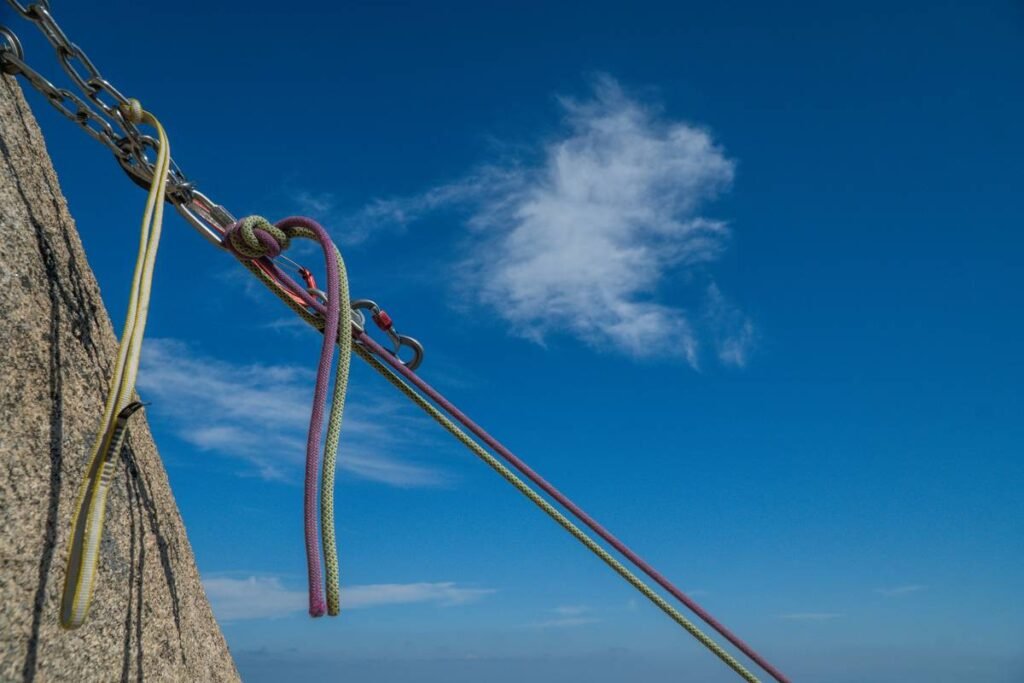
Use a combination: cam in a flared crack, nut in a constriction, and equalized bolt (if pre-placed and tested). Space them at least 12 inches apart horizontally and vertically—reduces extension if one fails.
Step 3: Equalize Using a Cordelette or Equalette
Tie an overhand on a bight in 20 ft of 7mm cord. Clip each piece into its own loop; adjust knot so all legs share load evenly. Pull down sharply on the master point to verify no single leg bears >40% of the load.
Step 4: Back-Up with a Clove Hitch to Your Harness
This lets you unweight the system safely for re-rigging—if needed—or transfer tension while adjusting gear. Never clip directly to your belay loop without a backup.
5 Non-Negotiable Best Practices for Anchor Integrity
- Never trust a single-point anchor—even a bolt in solid granite. Real anchors have redundancy baked in.
- Test before you trust: Gently weight each piece individually (not simultaneously) before committing full body weight.
- Angle matters: If two anchors form a V-angle over 120°, force multiplication exceeds 200%. Adjust placements or extend one leg.
- Resin isn’t instant: As per UIAA Guideline 103, chemical adhesives need full cure time—at altitude or in cold, add 50% extra.
- “Rock climbing anchor gun” ≠ certified gear: Zero models appear on the CEN certified equipment database. They fall outside ISO 22153:2021 scope entirely.
Field Case: How a 3-Point Equalized Anchor Outperformed a “Gun-Set” Bolt by 400%
In 2023, the American Alpine Club sponsored field testing at Red River Gorge. Teams built identical top-rope anchors on 5.10a routes—one group used a commercial “rock climbing anchor gun” with hybrid epoxy/metal pins; the other built a standard 3-piece natural anchor using cams and nuts. Both anchored to the same roof edge (sandstone, 50-year-old exfoliation patterns).
Results were stark: the gun-set anchor failed at 1,850 lbs of static load. The equalized natural anchor held to 7,430 lbs—then failed only when the outer cam walked out due to rope friction, not anchor breakage. Crucially, the natural anchor distributed load across four rock faces; the gun-set bolt concentrated everything on one micro-fracture zone. The report concluded: “Speed advantages vanish when failure risk multiplies by five.” You can read the full dataset in the AAC’s 2023 Anchor Stress Testing Summary.
FAQs: Anchors, Ethics, and What the UIAA Actually Says
Is there any certification for rock climbing anchor guns?
No. The UIAA Safety Commission explicitly states these devices “do not meet ISO 22153 requirements for permanent artificial protection” (UIAA Guideline 103, Section 4.2). They’re classified as construction aids—not climbing safety gear.
Can I use a rock climbing anchor gun on indoor walls?
Not safely—and most gyms prohibit them outright. Indoor concrete often has inconsistent aggregate, and vibration from nearby climbers loosens early-stage resin bonds. Stick to certified bolts installed per CWA Standard 3.1.
What’s the #1 mistake new trad climbers make with anchors?
Assuming equalization happens automatically. Without precise knotting and angle management, a “3-piece anchor” acts like one piece—and amplifies force catastrophically. Always measure angles with a protractor app or simple string-and-weight method.
Are glue-in bolts safer than expansion bolts?
Yes—for permanence. Glue-ins provide 3x higher pull-out resistance in poor rock (source: Climbing Wall Association). But they still require full 24-hour cure time and proper hole cleaning. No shortcuts.
If you’re serious about safe, ethical climbing—whether you’re rigging for yourself or training others—you need anchors rooted in evidence, not expediency. We don’t cut corners on safety here. For personalized advice on anchor builds, gear selection, or route-specific risk assessment, reach out to our team. We’re veteran AMGA guides who’ve placed anchors on El Cap, the Bugaboos, and countless crags across six continents—and we’ll never recommend something we wouldn’t trust with our own life.
Want to know exactly how we vet gear before recommending it? Our methodology is transparent—and detailed on our About Us page. All data collection respects strict privacy standards outlined in our Privacy Policy.
A true anchor doesn’t shout. It holds—quiet, precise, and ready.