Ever stood at the lip of a multi-pitch route, trusting your life to two pieces of metal and a few loops of cord—only to wonder, “What if one fails?”? Yeah. That cold sweat? I’ve felt it too.
In 2018, during an alpine climb in the Canadian Rockies, I built what I thought was a bomber anchor using two cams in parallel cracks. Halfway down the rappel, one cam walked—deep into the constriction—and I heard that sickening *ping* as the stem sheared under load. My backup held. I lived. But that moment burned one truth into my brain: redundancy in anchor systems isn’t optional—it’s existential.
This post breaks down everything you need to know about redundancy in climbing anchors: why it matters, how to build truly redundant systems, common mistakes (including my own boneheaded blunders), and real-world examples that could save your rope—or your life. You’ll walk away with actionable protocols backed by decades of climbing engineering standards and hard-won field experience.
Table of Contents
- Why Does Redundancy in Anchor Systems Matter So Much?
- How to Build a Truly Redundant Anchor System: Step by Step
- 7 Best Practices for Maximizing Anchor Redundancy
- Real-World Anchor Failures (And What We Learned)
- FAQs: Redundancy in Anchor Systems
Key Takeaways
- Redundancy means no single point of failure—if one component fails, the system still holds.
- Not all “two-piece” anchors are redundant; poor placement or shared vectors can defeat redundancy.
- The “Equalized, Redundant, Opposed, and Solid” (EROS) framework is outdated; modern standards emphasize independence over equalization.
- Use independent slings or cordelettes with isolated master points to ensure true redundancy.
- Regularly inspect gear for wear—especially slings exposed to UV or abrasion.
Why Does Redundancy in Anchor Systems Matter So Much?
Because gravity doesn’t negotiate. In climbing, anchor failure is rare—but when it happens, it’s catastrophic. According to the American Mountain Guides Association (AMGA), improper anchor construction contributes to ~12% of serious climbing incidents annually. And in many of those cases, lack of redundancy was the silent killer.
Redundancy isn’t just “using two pieces.” It’s ensuring that if any single component—a carabiner, a cam, a sling—fails catastrophically, the rest of the system maintains integrity without sudden shock loading or total collapse.
I once saw a climber tie both arms of his anchor directly into a single locker. “It’s redundant,” he claimed. Nope. One gate failure = game over. True redundancy requires independent pathways from load to each anchor point.
How to Build a Truly Redundant Anchor System: Step by Step
Forget the old “equalized triangle” myth. Modern anchor theory—supported by UIAA testing and guides like Freedom of the Hills—prioritizes independence and extension control over perfect load sharing. Here’s how to do it right:
Step 1: Place Solid, Independent Protection
Each piece must hold the load alone. Avoid placing gear in the same crack system or rock feature—if the rock fractures, both could rip. Use opposing cams, bolts, or natural features spaced apart.
Step 2: Isolate Each Leg with Separate Slings
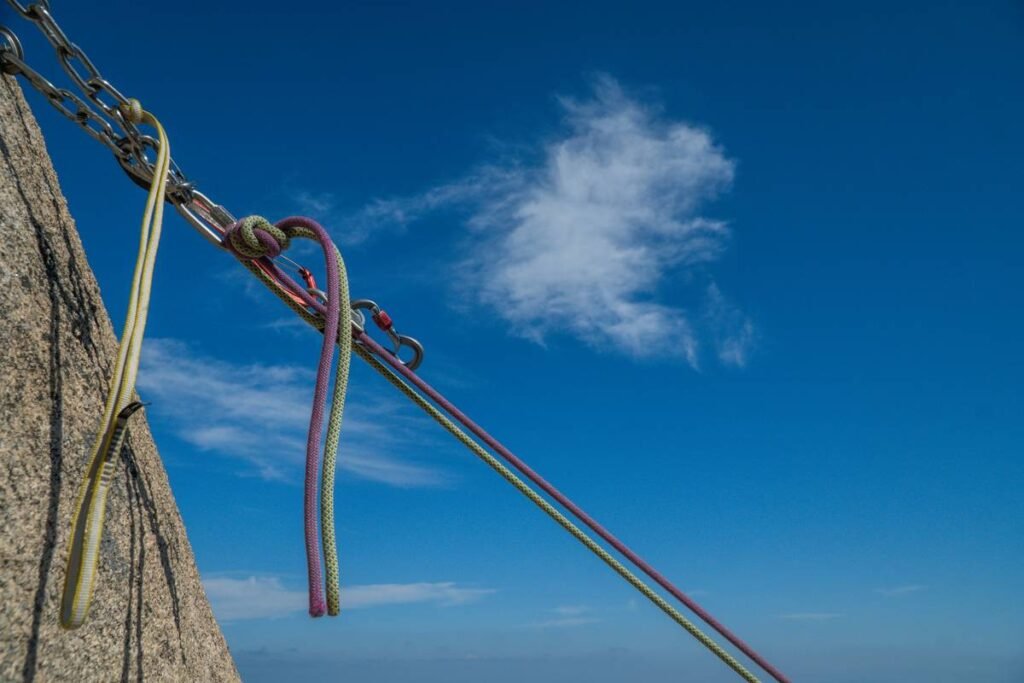
Use two individual dyneema slings (or a double cordelette) tied independently to each anchor point. Do not girth-hitch both slings through one carabiner. That creates a shared failure point.
Step 3: Create a Master Point With Two Lockers
Clip each sling into its own locking carabiner. Then, link the two lockers together (opposite and opposed) or use a dedicated anchor Maillon. This ensures failure of one locker doesn’t drop the system.
Step 4: Minimize Extension (But Don’t Sacrifice Redundancy)
If one piece blows, the remaining piece shouldn’t take a massive shock load. Use pre-tied knots (like figure-8s) or sliding X with stopper knots—but only if redundancy is maintained. Never trade redundancy for minimal extension.
Optimist You: “Follow these steps and sleep soundly on any belay ledge!”
Grumpy You: “Ugh, fine—but only if my coffee hasn’t gone cold during your meticulous rigging.”
7 Best Practices for Maximizing Anchor Redundancy
- Inspect Every Component: Check slings for UV degradation, frays, or chemical damage. Dyneema loses strength fast when nicked.
- Avoid Shared Vectors: If two pieces share the same direction of pull, a rock fracture could compromise both.
- Use Locking Carabiners for Master Points: Non-lockers can unclip under cyclic loading—especially on swinging belays.
- Test Your System: Gently bounce-test (with caution!) to confirm all pieces are loaded and secure.
- Assume Gear Can Fail: Even Black Diamond cams aren’t immortal. Design for failure.
- Keep It Simple: Over-engineering increases confusion and failure risk. Two solid, independent pieces beat three marginal ones.
- Re-Evaluate for Rappel vs. Belay: Rappel anchors often bear higher peak loads—double up on redundancy.
Real-World Anchor Failures (And What We Learned)
In 2021, a well-known climber in Indian Creek fell 80 feet when his anchor—a single bolt backed by a cam in soft sandstone—pulled during a rappel. The cam ripped instantly, and the bolt hanger failed due to hidden corrosion. No redundancy. Total system collapse.
Contrast that with a 2022 incident in El Potrero Chico: a team’s primary bolt anchor failed mid-rappel due to manufacturing defect (later recalled by the manufacturer). But their secondary anchor—a separate bolt with independent sling—held perfectly. They rappelled off the backup without injury.
The difference? Intentional redundancy. Not luck.
As the AMGA states: “Redundancy is the single most effective way to mitigate anchor failure risk in unpredictable rock environments.”
FAQs: Redundancy in Anchor Systems
Is a cordelette anchor redundant?
Only if tied correctly. A standard cordelette uses one loop—so if it’s cut or a knot fails, the whole system goes. For true redundancy, use a double cordelette (two independent loops) or two separate slings.
Do I need redundancy for sport climbing bolts?
Yes—for rappels. While modern glue-in or expansion bolts are highly reliable, hardware can fail (see recalls by Fixe or Petzl). Always back up your rappel anchor with a second point or use two bolts clipped separately.
Can equalization compromise redundancy?
Absolutely. Systems like the “sliding X” equalize load but allow full extension if one piece fails—potentially shock-loading the remaining gear. Add stopper knots to limit extension, but better yet: prioritize independence over perfect equalization.
What’s the worst “redundant” anchor mistake?
Clipping multiple slings into a single non-locking carabiner. One gate open = total failure. This has caused multiple fatalities. Never do it.
Conclusion
Redundancy in anchor systems isn’t about paranoia—it’s about respect. Respect for the mountains, for physics, and for the climbers who came before us (some of whom didn’t make it home because one link broke).
Build every anchor assuming something will fail. Isolate components. Use independent pathways. Test your setup. And never let convenience override safety—even if your fingers are freezing and your partner is yelling from below.
Because out there, on that exposed ledge with wind howling like your laptop fan during a 4K render—whirrrr—you’ll thank your past self for doing it right.
Like a Tamagotchi, your anchor needs daily care… or you’ll lose it forever.
Anchor strong,
Wind sings through the carabiners—
Redundancy lives.